
Student Spotlights
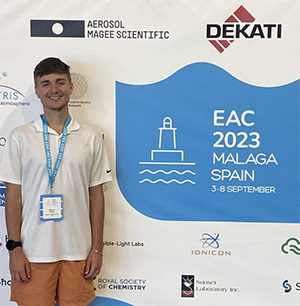
Ethan Barber received $200 SAFE Fund for equipment & supplies on Ultrasonic Humidifier Project for Graduate Research Travel to the European Aerosol Conference as Dr. James Sherman’s Research Assistant Dr. Sherman and I were fortunate to embark on an enriching journey to Málaga, Spain this semester, where we had the privilege to participate in the European Aerosol Conference 2023. During this event, we had the opportunity to share our work, build valuable connections with colleagues from around the globe, and gain insights from their expertise. Not only did this experience allow me to *attempt* to communicate in my very basic Spanish, but it also provided us with a platform for collaboration with scientists from institutions that share our research focus and employ similar instrumentation as we do at AppalAIR (Appalachian Atmospheric Interdisciplinary Research site). Moreover, we were granted the chance to engage with various equipment vendors who produce the innovative instruments we have recently integrated into our research projects as part of the new grants awarded to our group. A surprising highlight of the trip was running into a former Appalachian State student, who graduated from the Chemistry Department several years ago and is now a post-doctoral researcher working in the Swiss Alps. This journey was an extraordinary and transformative experience that pushed me beyond my comfort zone, as I interacted with leading scientists and researchers in their respective fields. I am deeply grateful for this unique opportunity and highly recommend that other students seek out research groups in areas of their interest and become involved as soon as possible.
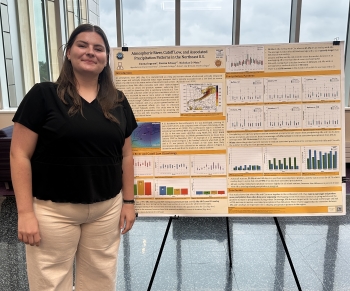
Emma Ingram searched the online NSF database for REUs in Atmospheric Science and found the Northeast Partnership for Atmospheric and Related Sciences (NEPARS). There were two colleges that you could be placed at, Emma was placed at Hobart and William Smith Colleges in Geneva, NY. The REU was a nine-week program that took place over the summer. She conducted research under Dr. Nicholas Metz. Emma's research focused on developing a climatology for Cutoff Lows, Atmospheric Rivers, and their associated precipitation patterns in the Northeastern United States.While there she travelled to Plymouth State University and the University at Albany to present her research and paper, Atmospheric River, Cutoff Low, and Associated Precipitation Patterns in the Northeast U.S. This was wonderful presentation practice and practice receiving feedback from audience members and faculty. Emma also recieved a good introduction to the research process. Most of the research was done independently with periodical check-ins from her mentor. This gave her good insight into conducting her own research and making important decisions about the research on her own. However, one of the most rewarding parts of this REU was the cohort of people she was with. Emma conducted research alongside 11 other undergraduates from all across the United States. This opportunity also allowed Emma to present her research at the American Geophysical Union conference and at the American Meteorological Society conference later that year.
“I have always been interested in atmospheric science, but I have become more interested in the subject since working at the AppalAIR research facility here at App. It was so wonderful to live and work with such amazing people and get insight into their own projects and interests. I was the only physics major at this REU and do not have much of a background in atmospheric science or meteorology, so being able to learn from my mentors and cohort members was something I really cherish. Geneva, NY is also such a beautiful place to spend the summer, the town is situated alongside Seneca Lake, with provided some wonderful sunset and sunrise views over the lake!"
Hengming Li, a Physics major with en emphasis in electrical engineering, was selected to receive a scholarship through the Appalachian High Achievers in STEM program. This program is funded by a 2018NSFS-STEM grant and exists to attract academically talented students to STEM degrees. The program provides a nurturing atmosphere that encourages excellence and builds collaborations between students, faculty, and the community.
At Appalachian, Li works with Dr. François Amet studying the electronic and thermal properties of materials at the nanoscale using nanofabrication techniques to design electronic devices with tailoredelectronic properties. They explore the novel phenomena that emerge in these structures at low temperatures, close to absolute zero.
Li received a National Institute of Standards and Technology (NIST) Summer Undergraduate Research Fellowship (SURF). He has been working at NIST in Gaithersburg, MD this summer on the process development of area-selective atomic layer deposition (ALD) by using a novel fluorinated polymer. This new polymer has the potential to facilitate various nanodevice fabrications.
Li is a pianist, a linguists, a tutor, a researcher, a member of the LGBTQ communitiy, and much more. After graduation, he plan to attend a Ph.D. program in order to research and explore the possibilities in the intersection of neuroscience, artificial intelligence, physics and electrical engineering.
Mr. Jeff Miller was awarded a competitive travel award from the Society of Physics Students (SPS) and an ASU OSR travel grant to present a poster at the American Association of Physicists in Medicine meeting in Nashville, Tennessee. Miller is a senior Physics major with an emphasis in medical physics. Miller also received an NC Space Grant Undergraduate Research Fellowship for summer 2018 to work with Dr. Brooke Hester as a research assistant in the BiyOSeF research group. Miller's project is the determination of the elastic modulus of cells with optical tweezers. Optical tweezers is a technique that uses light to grab hold of small objects, manipulate them, and measure any forces that might be acting on them.
Senior Julia Hinds is was an intern at Fermi National Accelerator Laboratory researching with the Dark Energy Survey – Gravitational Waves group.
“I am working on DES-GW (Dark Energy Survey - Gravitational Waves) pipeline for imaging subtraction between DECam (Dark Energy Camera) and PanSTARRS (Panoramic Survey Telescope and Rapid Response
System),” Julia said. “One already exists for DECam images but not for PanSTARRS. By adding PanSTARRS images, we increase our overall sky coverage. It will help us fill in the gaps where we do not have DECam images. The detection of electromagnetic (EM) and gravitational-wave (GW) emission from astrophysical sources is one main events present day astronomers hope to achieve. GW events have several possible progenitors, including black hole mergers, cosmic string cusps, supernovae, neutron star mergers, and black hole - neutron star mergers. The LIGO-Virgo Collaboration has agreed to send GW alerts as well as coordinates of these gravitational events, so by using the DES-GW pipeline, the EM counterparts can be pursued. We hope to run a test event at the beginning of August."